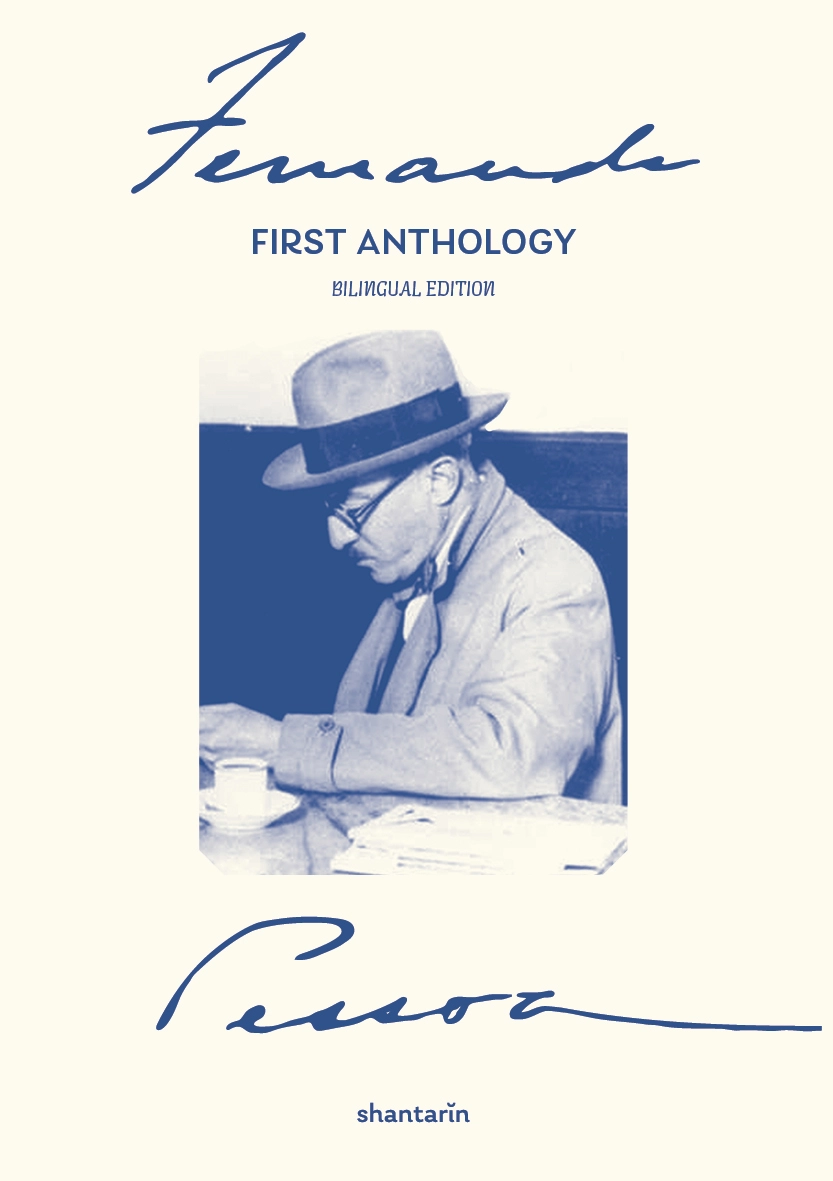
Fernando Pessoa’s Letter on the Genesis of the Heteronyms
Fernando Pessoa’s Letter on the Genesis of the Heteronyms
Post Office Box 147
Lisbon, 13th of January 1935
My Esteemed Friend,
I’m grateful for your letter, to which I will respond immediately and in full. Before I actually begin, I want to apologize for writing to you on onionskin. I’ve run out of proper typing paper, it’s Sunday, and I can’t get out to buy something decent. But better bad paper, I think, than delay.
First, I just want to say that I would never see “ulterior designs” in anything that you might write in disagreement with respect to me. I’m one of the few Portuguese poets who has not decreed his own infallibility, nor taken any criticism against himself as an act of lese-divinity. Moreover, whatever my mental defects might be, there’s no trace in me of any persecution syndrome. At any rate, I’m already sufficiently aware of your intellectual independence, which, if you’ll allow me to say, I approve of greatly and commend. I never set out to be a school-master or a chef, since I don’t know how to teach and I doubt I’ll ever have to; chef, because I don’t even know how to fry an egg. So, don’t worry, ever, about anything you might have to say about me. I’ve never been one for snipe hunts.
I agree with you completely that debuting my work with a book like Message was hardly felicitous. I am, in fact, a mystical nationalist, a rational Sebastianist. But I am also, and even completely contrary to this, many other things. And Message omits these things because of the very nature of the book.
I started to publish with this book for the simple reason—and I don’t know why this is so—that it was the first book I was able to put together and get ready. Since it was ready, they convinced me to publish it: I agreed. I didn’t even do it, I should say, with an eye to the possible prize from the Secretariat, though there was no major intellectual sin in this. My book was ready in September, and I even thought that I wasn’t eligible to run for the prize, since I thought I had missed the deadline for submitting books, which was initially set for the end of July, but was extended to the end of October. However, given the fact that at the end of October copies of Message were already out, I submitted what the Secretariat had asked for. The book matched precisely the conditions (nationalism) set for entering the prize . So, I entered.
At times, when I thought about the order in which I would publish my works in the future, a book like Message never figured as the first one. I hesitated between beginning with a large book of verse—a book of some three hundred and fifty pages—that would include various subpersonalities of Fernando Pessoa himself, or whether I should go with a detective novel, which I still hadn’t been able to finish.
I agree with you, as I said, that this was not a happy debut, which I alone am responsible for by publishing Message. But I’m certain that in fact it was the best debut that I could have had. That is because this facet of my personality—secondary in a certain way—had not been sufficiently evident in my collaborations with magazines (except in the case of “Portuguese Sea, one of the sequences in Message)—for this reason alone it was appropriate that it be made evident, and that it appear now. This coincided, without any planning or premeditation (I’m incapable of being practical or premeditating anything), with one of the critical moments (in the original sense of the word) in the remodeling of the national subconsciousness. What I did by chance and what was bolstered by all the talk of others, had been perfectly sketched out, with Square and Compass, by the Great Architect.
(But let me interrupt myself. I am not crazy or drunk. I am, however, writing straightforwardly, as quickly as my typewriter permits, and am grabbing at expressions that occur, without worrying about whether there is any literature in them. Just imagine—and it’s good that you do, because it’s the truth—that I am simply talking to you.)
I’ll respond directly to your three questions: (1) the plan for the future publication of my work, (2) the genesis of my heteronyms, and (3) occultism.
Having published Message, as I described above, and the fact that it is a unilateral representation of my work, I plan to proceed in the following manner. At the moment I’m finishing a completely recast version of “The Anarchist Banker”; it should be ready soon and, once it’s done, I expect to publish it without delay. If this goes ahead, I’ll translate it into English straight away, and then I’ll see if publication in England is possible. It’s precisely in this form that its European prospects will be assured. (Don’t take this in the sense of an imminent Nobel Prize.) After this—to address without further ado your question in terms of poetry — I intend, during the summer, to put together that large volume of short poems written by Fernando Pessoa himself, and will see if I can publish it by the end of this year. This is the book you’ve been waiting for, and it’s also the one that I wish to see published. Taken altogether, these poems will represent all the different facets, except the nationalist, which Message already embodies.
As you can see, I am referring to Fernando Pessoa alone. I mention nothing about Caeiro, about Ricardo Reis or Álvaro de Campos. I won’t be able to do anything about them, in terms of publishing, until (see above) the Nobel Prize is awarded to me. And yet—and this brings me great sadness—I put all my powers of dramatic depersonalization into Caeiro, all of my mental discipline went into Ricardo Reis, dressed in his very own music, and all of the emotion that I allow neither myself nor express in my life I put into Ávaro de Campos. To think, my dear Casais Monteiro, that all of these must be passed over by the simple, impure Fernando Pessoa.
I hope that this answers your first question.
If I’ve left anything out, tell me. If I can say more, I will say it. I have no plans beyond these for the time being. And knowing what my plans are like, and how they always end up, the only thing left to say is Thank the lord!
I’ll turn now to your question about the genesis of my heteronyms. Let’s see if I’m able to respond in full.
I’ll begin with the psychiatric part. The origin of the heteronyms is a profound hysteria in me; I don’t know if I’m simply hysterical, or if I am, more properly speaking, a hystero-neurasthenic. I tend more to the second hypothesis, since hysteria itself and its set of symptoms would not account for the fact that in me there are phenomena of abulia. Whatever it is, the mental origin of my heteronyms is in my constant and organic tendency towards depersonalization and dissemblance. These phenomena—fortunately for me and everyone else—are relegated to my imagination, that is to say they don’t show up in my practical life, in my public life when I am in contact with others; they explode within me—and I experience them alone with myself. If I was a woman—in a woman hysterical phenomena burst out in attacks and similar things—each of Álvaro de Campos’s poems (for he is the most hysterically hysterical part of me) would alarm the neighbors. But I am a man—an in men hysteria in the main manifests itself mentally, such that everything ends up in silence and poetry…
This explains, tant bien que mal, the organic origin of my heteronomy. So, I will now give you the real history of my heteronyms. I begin with those who have died, and some of those I can’t even remember—those who are now lost in the distant past of my nearly forgotten childhood.
Starting in childhood, I had the tendency to create a fictitious world all around me, of surrounding myself with friends and acquaintances that never existed. (Though, for all intents and purposes, I don’t really know if they existed or not, or if it is myself that does not exist. In these matters, as in everything else, we should never be dogmatic.) From the time that I knew myself as the one I call me, I remember delineating in my mind, in terms of figure, movement, character and story, various unreal likenesses that were so visible to me and so much my own as to be like those things that we call, perhaps abusively, real life. This tendency, that has been with me as far back as I can remember being an “I,” has always accompanied me, altering somewhat in the kind of music with which it charms me, but never its way of charming.
This is how I remember what seems to have been my first heteronym, or rather, my first inexistant acquaintance—a certain Chevalier de Pas from my sixth year, for whom I used to write letters, from him to myself, and whose figure, not entirely vague, still captures a part of my affections in a way that borders on longing. I remember, with less clarity, another figure, whose name no longer occurs to me but who was also foreign and who was, I don’t know how, Chevalier de Pas’ rival… Things that happen to all children? Doubtlessly, or maybe. But I experienced them so completely that I still experience them, because I remember them in such a way that it is almost impossible to convince myself that they weren’t real.
This tendency for creating another world around me, equal to this one but with other people, never left my imagination. It went through various phases, even when I had already come of age. Some witty saying would occur to me, for one reason or another, that was completely out of character with who I am, or who I suppose I am. I would blurt it out, spontaneously, as though some friend of mine were saying it, whose name I’d invent, making up the story of who they were, the figure they cut—their face, height, way of dressing, gestures—and right away I’d see them in front of me. And that’s how I came up with and gave birth to a variety of friends and acquaintances that never existed, but who still today, thirty years later, I hear, and feel, and see. I repeat: hear, feel, see… and I miss them.
(When I start talking—and typing for me is talking—, I find it hard to put on the brakes. Surely, I’m being tedious, Casais Monteiro! So, I’ll begin with the genesis of my literary heteronyms, which is, after all, what you want to know. In any case, what I’ve said above tells the story of the mother who brought them to term.)
Around 1912, if I’m not mistaken (and if I am it’s not by much), the idea came to me to write some poems of pagan character. I sketched out some things in irregular forms (not in the style of Álvaro de Campos, but in a semi formal way), and then I abandoned them. A vague portrait of the person who was writing began to take shape, however in a poorly woven penumbra. (Ricardo Reis had been born without me knowing it.)
A year and a half, or two years, later I remember that one day I decided to play a trick on Sá-Carneiro—by inventing a bucolic poet, of a complicated kind, whom I would introduce him to, I don’t remember how, as somehow real. I spent a few days trying to invent the poet but wasn’t able to. On the day I finally gave up—it was the 8th of March, 1914—I went over to a high dresser, and, taking out a sheet of paper, I started to write, standing up, as I always do when I can. And I wrote about thirty poems in a row, in a kind of ecstasy the nature of which I can’t describe. It was the most triumphal day of my life, and I’ll never have one like it again. I began with the title, “The Keeper of Sheep.” And what followed was the appearance of someone inside of me, whom I immediately named Alberto Caeiro. Forgive me the absurdity of this sentence: my master had appeared in me. That was the immediate sensation I had. And this was so strong that, having written these thirty-odd poems, I immediately grabbed another sheet of paper and wrote, again, one after another, the six poems by Fernando Pessoa that make up Oblique Rain. Immediately and totally… It was Fernando Pessoa Alberto Caeiro turning back into Fernando Pessoa himself. Or, rather, it was Ferando Pessoa’s reaction against his own non-existence as Alberto Caeiro.
With the appearance of Alberto Caeiro, I straight-away—instinctively and subconsciously—went on to try to discover some disciples for him. From his false paganism I pulled an inchoate Ricardo Reis, I discovered his name, and arranged him to suit himself, because, by then I could already see him clearly. And suddenly another individual, the origin of whose character sharply contrasted with that of Ricardo Reis, arose out of me with great force and spontaneity. In an outpouring at the typewriter, without any interruption or amendment, Álvaro de Campos’ “Triumphal Ode” made its appearance—the ode by that name, and the man too, with his name.
In this way, then, I created an inexistent coterie. I framed everything as though it were real. I rated influences, came to know their friendships, I heard, inside me, sharp conversations and differences in criteria, and in all this it seems to me that I, the creator of everything, was the least of it. It seems that it all happened independent of me. And it seems like that’s how it still happens. If one day I can publish the aesthetic wrangling between Ricardo Reis and Álvaro de Campos, you’ll see how different they are, and how I am not even part of it.
When it came time to publish Orpheu and, at the last minute, we needed something to complete the allotted amount of pages, Sá-Carneiro suggested that I do one of Álvaro de Campos’s “older” poems—something from before he came to know and fall under the influence of Caeiro. And so I wrote “Opiary” in which I attempted to show all of Álvaro de Campos’s latent tendencies, as they would be revealed at a later date, but which still did not show any trace of having come into contact with his master Caeiro. Of all the poems I’ve written, this was the one that gave me the most work, because of the double depersonalization that needed to be mustered. But, in the end, I believe it didn’t go badly, and that it shows us Álvaro about to blossom…
I think I’ve explained the origin of my heteronyms. But if you need clarification about anything—because I’m writing quickly, and when I write quickly I’m not very clear—just tell me, and I’ll gladly give it to you. And, just to add something else that’s quite true and a bit hysterical: when I was writing certain passages from Notes For the Memory of My Master Caeiro, by Álvaro de Campos, I actually broke down and cried real tears. That’s just so you’ll know who you’re dealing with, my dear Casais Monteiro!
Let me give you a few more notes on this material… I see before me, in a colorless but real dream space, the faces, the gestures of Caeiro, Ricardo Reis and Álvaro de Campos. I’ve given them ages and lives. Ricardo Reis was born in 1887 in Porto, (I don’t recall the day or the month, but I’ve noted them down somewhere); he’s a doctor and is currently living in Brazil. Alberto Caeiro was born in 1889 and died in 1915; he was born in Lisbon but lived nearly his whole life in the countryside. He had no profession and hardly any formal education. Álvaro de Campos was born in Tavira, on October 15th, 1890 (at 1:30 in the afternoon, I was told by Ferreira Gomes; and it’s true, because the horoscope for that hour bears it out). As you know, his background is in naval engineering (by way of Glasgow) but he’s here in Lisbon now and is not practicing his profession. Caeiro was of medium height, and, though quite fragile (he died of tuberculosis), he did not seem as fragile as he really was. Ricard Reis is slightly, but ever so slightly, shorter, stronger and lean. Álvaro de Campos is tall (1.75 meters, 2 more centimeters than me), slender and tends to stoop. All of them are clean shaven—Caeiro is fair haired and pale, blue eyes; Reis is somewhat more darkly complected; Campos somewhere between light-skinned and dark, looking vaguely like a Portuguese Jew, though with fine straight hair parted at the side, and wearing a monocle. Caeiro, as I said, had no more than a small amount of schooling—just primary; his father and mother died young, and he was able to remain at home, living off a small income. He lived with an old aunt, a great-aunt. Ricardo Reis, educated at a Jesuit high school, is, as I said, a doctor; he has lived in Brazil since 1919, choosing to emigrate since he’s a monarchist. He is a Latinist by education, and a self-taught semi-Hellenist. Álvaro de Campos had a normal high school education after which he was sent to Scotland to study engineering, mechanical then naval. On one of his holidays, he took a trip to the Orient which resulted in the poem “Opiary.” An uncle, a priest from central Portugal, taught him Latin.
How do I write under these three names?... Caeiro with pure and unexpected inspiration, without knowing or even calculating what I am going to write. Ricardo Reis, after deliberating abstractly, which suddenly forms itself into an ode. Campos, when I feel the sudden impulse to write and I don’t know about what. (My semi-heteronym Bernardo Soares, who, in many ways, seems like Álvaro de Campos, always appears when I’m worn out and sleepy, so that my qualities of reasoning and inhibition are suspended somewhat; that prose comes out like an ongoing dream. He’s a semi-heteronym because, while not having my personality, his is not different from mine, but rather a simple disfigurement of it. He’s me minus my reasoning and affectivity. The prose, except for the ténue that reason adds to my own, is equal to mine, and in perfectly equivalent Portuguese; while Caeiro writes Portuguese badly, Campos reasonably yet with certain infelicities like saying “as for me” instead of “I for one,” etc., Reis writes better than I do, but with a purity I consider exaggerated. The difficult thing for me is to write Reis’ prose—which is still unpublished—or Campos’. In verse, the simulation is easier, simply because it’s more spontaneous.)
By now you must be wondering what bad luck it is to have stumbled into a madhouse just by reading a letter. In any case, the worst thing about this is that I’m writing so incoherently. I repeat, however, I’m writing as though I were simply speaking to you, so that I can get the job done right now. If that weren’t so, it would be months before I’d be able to write.
That only leaves me to respond to your question about occultism. You ask me if I believe in occultism. Asked in this way, the question is not totally clear; I nevertheless understand its intention and that is what I will respond to. I believe in the existence of worlds that are superior to ours and in the inhabitants of these worlds, in experiences that rise to a variety of degrees of spirituality, becoming increasingly subtle until you reach a Supreme Being, who presumably created this world. It could be that there are other Beings, equally Supreme, who have created other universes, and that these universes coexist with ours, perhaps even merging with ours, or not. For these and still other reasons, the Extreme Order of Occultism, that is, Freemasonry, avoids (with the exception of Anglo-Saxon Freemasonry) the expression “God,” given its theological and popular implications, and prefers to say “Great Architect of the Universe,” an expression that leaves open the question of whether He is the creator, or simply the Governor of the world. Given these scales of beings, I don’t believe in direct communication with God, but that we are able to communicate with increasingly higher beings in proportion to our spiritual attunement.
There are three paths to the occult: the path of magic (including practices like spiritualism, intellectually the equal of sorcery, which is also magic), in all of its forms an extremely dangerous path; the path of mysticism, which is not in itself dangerous, but is slow and uncertain; and that which is called the path of alchemy, the most difficult and most perfect of all, because it involves the transmutation of the personality itself which prepares it, without great risks, even with protections which the other paths don’t have. As to the “initiation” or not, I can only say the following, without knowing if it answers your question: I do not belong to any Initiatory order at all. The citation, an epigraph to my poem Eros and Psyche, from a translated passage (since the Ritual is in Latin) of the Ritual of the Third Step of the Order of the Templars of Portugal, simply indicates—which is a fact—that I was allowed to leaf through the Rituals of the first three degrees of that Order, which has been extinct, or dormant since 1888. If it hadn’t been dormant, I wouldn’t have cited the passage from the Ritual, since we shouldn’t cite passages (which would indicate the origin) from Rituals that are in use.
So, my friend, I believe I’ve responded, albeit with some incoherence, to your questions. If you’d like to ask any others, don’t hesitate. I will respond as best I can. What could happen, and I’ll apologize in advance, is that I don’t respond as quickly.
With a warm embrace to my dear friend,
who I esteem and admire greatly,
Fernando Pessoa
P.S. (! ! !) 14/1/1935
Whenever I write at the typewriter, in addition to the copy I usually make for myself of any letter that involves explanations on the order of the ones contained here, I’ll make a supplementary copy, both in case the letter gets misplaced, and, as well, in case it is, possibly, needed for some other end. This copy will always be at your service.
One more thing. It could be that, for one of your studies, or some similar end, you could need, in the future, to cite one or another passage from this letter. I give you my authorization to do so now, but with only one caveat, which I ask your forgiveness for making. The paragraph on occultism, on page seven of my letter, cannot be reprinted. By wanting to respond as clearly as possible to your question, I went on purpose a bit beyond the limits that are normal for this kind of material.
This is a personal letter, and for this reason I didn’t hesitate to do what I did. Nothing prevents people who want to from reading this paragraph, if this other person also obeys the criterion of not printing what is written there. I believe I can count on you to uphold this proscription.
I still owe you the badly overdue letter on your latest books. I still hold by what I believe I told you in my earlier letter: when I spend some time in Estoril (I think it will not be until February), I will bring this correspondence up to date, since I’m behind on these things not only with you, but also with various other people.
It occurs to me to ask once again something that I already asked you and to which you didn’t respond: did you receive my chapbooks of English verses which I sent some time ago?
“Just for the record,” as we say in commercial jargon, I would ask you to indicate as soon as possible that you have received this letter. Thank you.
F. Pessoa
Translated by Martin Earl for